
Most founders don’t think about consultant requirements for FP&A until something breaks. In practice, an FP&A consultant builds the planning and analysis system a growing service business needs: budgeting, forecasting, cash flow modeling, scenario planning, real-time KPI reporting, and dashboards that turn financial data into decisions.
Cash flow gets tight, payroll feels risky, or you suddenly realize your margins have been slipping for six months and no one caught it. That pattern is common in service businesses doing $1M–$20M in revenue, where growth outpaces financial visibility and founders start making hiring, pricing, and spending decisions without a reliable planning process.
At that point, you don’t just need better reports. You need a system that keeps the business aligned, funded, and growing on purpose—and shows you what happens before you hire, expand, or commit to new overhead.
That’s what FP&A is for. Below, you’ll see what FP&A consulting actually is, what an FP&A consultant does inside a service business, why many small businesses wait too long to add it, what impact it can have on cash flow and decision-making, and how to tell when it’s time to bring in support.
What Is Financial Planning and Analysis?
FP&A stands for financial planning analysis. In plain English, it’s a corporate finance function that uses financial data to evaluate business performance, create a clear financial plan, track progress in real time, and steer the business before things go off track.
You’re not just building a budget. You’re turning your business strategy into numbers, timelines, hiring plans, and revenue targets you can actually manage to, which supports strategic planning and helps leadership make informed decisions.
A real FP&A system should answer questions like—and produce actionable insights and strategic insights, not just reports:
- Can we afford to hire this person now?
- Are we tracking ahead or behind on gross margin?
- How much cash will we have in 90 days if nothing changes?
- What’s our breakeven point by department or team?
Effective budgeting and forecasting also help improve forecast accuracy and capital allocation while strengthening financial health.
If you don’t have fast, reliable answers to those, you’re not running FP&A—you’re just looking in the rearview.
Want to see how this works in practice? Explore our FP&A consulting services to learn how we build systems that drive financial clarity and control.
What Does an FP&A Consultant Actually Do? (Including Financial Reporting)
An FP&A consultant builds the systems that answer those questions, with financial modeling and scenario analysis as core deliverables.
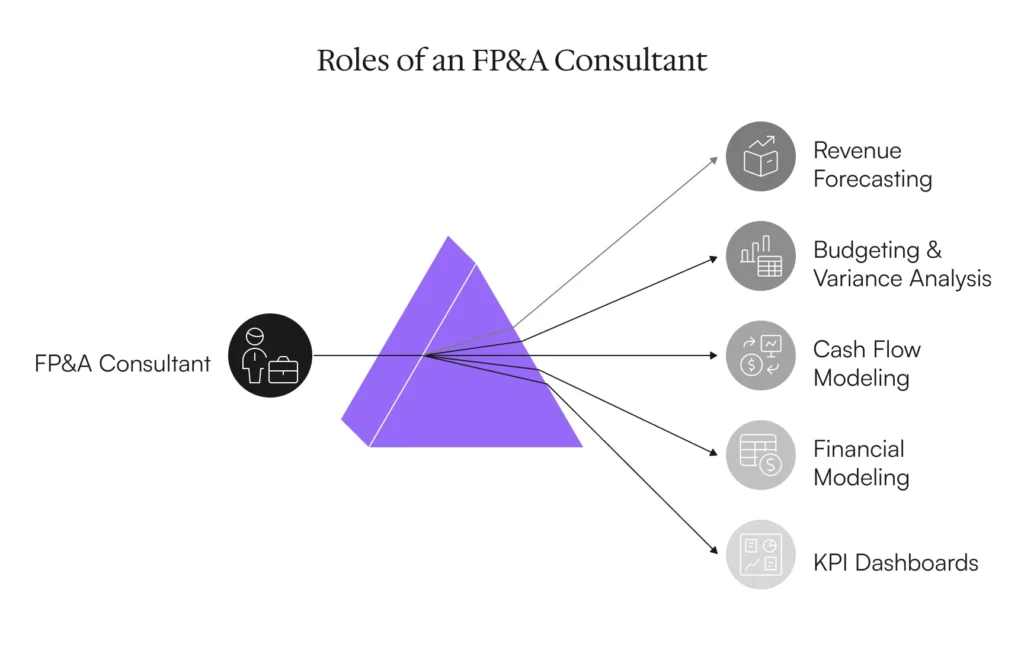
They don’t just deliver reports. They create data driven financial solutions for decision support across business units, using financial forecasts to connect strategy to execution. That includes:
- Budgeting and forecasting, which improves forecast accuracy and capital allocation
- Real-time KPI reporting
- Monthly financial analysis and variance analysis
- Cash flow modeling for cash flow management and working capital
- Performance dashboards by team, service line, or location
- Scenario planning grounded in operational realities
- Board and investor reporting
- Sales compensation modeling and ops support
These systems also strengthen management reporting, financial reporting, and recommendations to the executive team and key stakeholders.
Depending on the business, this can be a solo analyst or a full fractional CFO function. The goal is the same: financial visibility, proactive decisions, and a structure that scales. In some companies, the consultant acts as an extension of the internal finance team or supports senior team members in a Senior FP&A capacity.
Learn more about how we build these systems in our FP&A consulting approach.
Why Most Small Businesses Don’t Do This (Until It Hurts)
Most service businesses grow fast without upgrading their finance function. In small businesses, owners often delay building a dedicated FP&A role, while larger organizations usually add that support sooner.
But when revenue climbs and the team expands, the problem is not just missing reports. It is missing professional FP support that can identify areas of risk, improve budgeting to strengthen forecast accuracy and capital allocation, and connect planning to operational realities:
- Cash doesn’t match the P&L
- You’re hiring reactively
- No one owns budget accountability
- Forecasts don’t exist or are stuck in spreadsheets
- Margin trends go unnoticed until it’s too late
Without FP&A, leadership loses visibility into the company’s finances, forecast accuracy, and overall financial health.
That’s when you start bleeding cash, overstaffing, undercharging, or missing growth opportunities.
You don’t need more data. You need a system that turns data into action.
That’s exactly what our FP&A consulting services are designed to do.
What Happens When FP&A Works
We’ve seen this firsthand.
A cybersecurity firm came to us with no forecasting process. Hiring was erratic. Revenue looked good but cash was unpredictable. We built a dynamic model that functioned as a 13-week cash flow model, tying revenue targets to hiring, margins, burn rate, cash flow management, and working capital visibility to support stronger liquidity planning. Financial modeling is one of the most sought-after skills in FP&A because it turns operating plans into usable forecasts, supports data driven analysis, and improves the organization’s financial health. The result: $400K in avoided staffing mistakes, $1.2M reinvested, and higher margin stability across the board.
Same thing with a service business that kept hitting payroll stress—even though the books looked fine. We mapped out revenue-per-tech, aligned it with compensation, and built a forecast that flagged issues 60 days in advance. We also defined the financial metrics they needed to monitor performance, generate better business insights, and drive growth. That process also surfaced proactive tax planning opportunities that can save businesses, including service businesses, $50K–$300K annually. They added $140K to the bottom line in 4 months.
That’s the difference. FP&A isn’t just about reporting what happened. It plays a pivotal role in turning financial data into actionable insights that help senior leadership improve financial performance and make better business decisions.
How to Know If You’re Ready for FP&A Support
If any of this sounds familiar, you’re ready:
- You’re growing, but cash is unpredictable
- You want to hire but don’t know the financial impact
- You can’t see department or service line profitability
- Month-end close takes too long
- Financials feel like a post-mortem, not a decision-making tool
FP&A is also a clear career path, often progressing from analyst to Senior FP&A, manager, director, vice president, and chief financial officer. Most professionals enter the field with a bachelor’s degree and typically build three to five years of corporate finance experience before moving into higher-responsibility roles. Professional certifications can also enhance credibility for financial planning consultants. Typical pay runs from $50,000–$98,500 for analysts, $90,000–$120,000 for senior analysts, $120,000–$150,667 for managers, $151,500–$203,750 for directors, $185,000–$262,000 for vice presidents, and $207,750+ for CFOs with FP&A backgrounds.
This is where FP&A changes everything. A strong corporate FP&A function plays a pivotal role in improving financial performance by strengthening the company’s financial strategy, supporting senior leadership, and improving forecast accuracy, monthly forecasting, and capital allocation in a changing business environment, creating a robust FP capability that supports sustainable growth, and many professionals build that progression by moving from one company to another rather than staying in one company. Not just for your systems, but for your role as CEO. You move from reactive to strategic. From guessing to leading.
Ready to install a system that drives every financial decision?