How Do You Maintain Accounting Accuracy? Ask a CFO
On this page
Article Summary
A business maintains accounting accuracy by giving one person or team full ownership of the accounting cycle and running a consistent rhythm of weekly categorization, monthly review and quarterly planning. The core systems are a month-end close within 5 to 10 days, full bank and credit card reconciliations, AR and AP visibility, accurate payroll, accrual-basis reporting for scaling businesses, and strong internal controls such as segregation of duties. Accounting software and AI speed up reconciliation and categorization, but accounting accuracy still depends on human review, a clear chart of accounts and reports structured to show margins.
Introduction: Why Accounting Accuracy Matters for Business Owners and Finance Leaders
Maintaining accounting accuracy is essential for every business owner, finance leader, and entrepreneur who wants to avoid costly mistakes and support sustainable business growth. Inaccurate financial records can lead to missed opportunities, compliance issues, and even financial losses. This article will walk you through the essential steps of maintaining accounting accuracy, explain why it matters, and provide actionable guidance for anyone responsible for a company’s financial health.
Right from the start, maintaining accounting accuracy means implementing consistent and rigorous processes for accurate financial reporting, including regular account reconciliations, strict internal controls, and automated accounting software. The steps involved include recording transactions promptly, reconciling accounts regularly, maintaining organized records, and more—all of which are crucial for protecting your business and enabling informed decision-making.
Essential Steps for Maintaining Accounting Accuracy
To help you get started, here’s a step-by-step summary of the most important actions you should take:
- Record transactions promptly and regularly – Enter all financial transactions daily or weekly to prevent backlogs and catch errors while details are fresh.
- Reconcile accounts weekly or monthly – Regularly compare your internal records to bank and credit card statements to identify discrepancies early.
- Maintain detailed and organized records – Store all financial documents in a centralized and secure system for easy access and audit readiness.
- Implement strong internal controls – Establish policies and procedures to prevent fraud and ensure every transaction is recorded correctly.
- Use accounting software to automate processes – Leverage technology to streamline record keeping, expense tracking, and reporting.
- Separate personal and business finances – Keep business and personal expenses and accounts completely separate to avoid errors and simplify tax preparation.
- Conduct periodic financial reviews – Regularly review your financial statements to identify discrepancies or unusual trends.
- Ensure segregation of duties – Assign different people to handle different parts of the transaction cycle to reduce the risk of errors or fraud.
- Adhere to GAAP or IFRS – Follow Generally Accepted Accounting Principles or International Financial Reporting Standards for compliance and consistency.
By following these steps, you’ll build a solid foundation for accurate accounting and better business decisions.
What Accuracy Actually Means
Accounting accuracy means maintaining detailed and organized records, implementing consistent and rigorous processes for accurate financial reporting, and ensuring all financial documents are stored in a centralized and secure system. This includes:
- Prompt and systematic recording of transactions to maintain accurate accounting records.
- Every charge coded to the correct category.
- Full monthly reconciliation of bank and credit card accounts.
- Reports structured to show margins, not just totals.
- Financial reports that are clear and actionable, even for non-finance professionals.
Clean records are not enough. You need a system that helps you run the business by maintaining organized accounting records as the foundation for actionable financial insights.
If your P&L doesn’t tell you what happened, what changed, and what needs attention, it’s just noise.
Transition: Now that you know what accounting accuracy looks like, let’s explore the real cost of getting it wrong.
The Real Cost of Inaccurate Financial Statements
Accuracy isn’t just about compliance—it’s about decision quality.
One of our clients, Danny, was running a fast-growing business. Revenue was up. The team was slammed. But every month felt like a grind. Profit was slipping, and he had no idea why.
The books were technically “done.” His accountant filed on time. There were no red flags. But the financials didn’t break out service lines. Labor was buried inside one big category. There was no margin visibility. No departmental reporting. Just a single net income number and a gut feeling that something was wrong.
Once we restructured his chart of accounts, rebuilt the reporting, and tied revenue to delivery costs, the real issue became obvious—his pricing didn’t support the comp model. His team was overdelivering on underpriced work.
We fixed it. Within 90 days, he added $140K to the bottom line.
But here’s the part that stings: the business had been leaking cash for over a year. If the books had been accurate and actionable, he would’ve seen it earlier. Without accurate accounting, it’s impossible to understand the true financial position of the business or conduct meaningful financial analysis to identify issues and opportunities.
That’s the real cost of bad data. Not just tax penalties. Not just slow reports. But missed decisions that cost real money.
Transition: To understand how to avoid these costly mistakes, let’s define what accounting accuracy actually means.
How Do You Maintain Accurate Financial Records?
You maintain accounting accuracy by assigning full ownership. One person—an in-house accountant or a dedicated accounting team—must be responsible for making sure the numbers are correct, complete, and on time. For many growing businesses, recognizing the clear signs you need a fractional CFO is just as critical as having someone own the day-to-day books. Having an accounting team or in-house accountant ensures that accurate records are maintained throughout the accounting cycle, which is essential for tax compliance, auditing, and legal adherence.
Not just who enters transactions, but who reviews them. Who checks for errors. Who connects the numbers to the real-world performance of the business.
Most business owners assume their CPA handles this. But CPAs focus on filing. They aren’t managing weekly categorization, reviewing your general ledger, or catching margin shifts.
A bookkeeper might handle data entry, but they’re not building the reporting system or closing the books consistently.
If no one owns the process from end to end, accuracy breaks down. Delays happen. Reports go unused. And the owner is left guessing, or managing the business based on last month’s cash balance.
Steps to Maintain Accurate Financial Records
- Assign ownership of the accounting cycle – Designate a person or team to manage everything from transaction entry to reporting.
- Ensure understanding of your business model and goals – The accounting team should know your operations and objectives.
- Schedule monthly review meetings – Meet regularly to review what changed and what actions are needed.
- Implement regular checks and balances – Review transactions, reconcile accounts, and verify accuracy at every stage.
Transition: With ownership and process in place, let’s look at the core systems that drive accounting accuracy.
The Core Systems That Drive Accuracy
You don’t fix accounting with a better spreadsheet. You fix it with process. Below are the core systems we install in every client’s business, and they’re a big part of the fractional CFO advantage that transforms growing businesses:
Month-end Close
Books need to close on a set schedule—ideally within 5 to 10 days. If you’re reviewing the prior month halfway through the current one, you’re already behind. Posting journal entries is a key part of the closing process to ensure all transactions are accurately recorded.
Real-time Categorization
Waiting until the end of the month is a mistake. Categorize weekly. That’s how you catch errors, avoid coding backlogs, and keep the reports usable. Consistent expense tracking and tracking transactions in real time are essential for maintaining accurate records.
Bank and Credit Card Reconciliations
Everything should match. No exceptions. If it doesn’t, the books aren’t trustworthy. Regularly compare internal records to bank statements as part of reconciling accounts to detect discrepancies and ensure data accuracy.
AR and AP Visibility
You should know who owes you money, who you owe, and when everything is due. That’s how you manage cash flow and avoid surprises.
Payroll Accuracy
Misclassifications here trigger penalties and create confusion around labor costs. You need to tie payroll directly to margin reporting and cash planning, especially if cash is already tight and you could benefit from fractional CFOs focused on cash flow growth.
Accrual vs Cash Basis Clarity
If you’re scaling, accrual accounting gives a more accurate view of profitability. Cash basis works for taxes, but it lies to you operationally. This is especially true for recurring-revenue firms, where a fractional CFO for SaaS companies can align metrics, revenue recognition, and reporting with how the business actually performs.
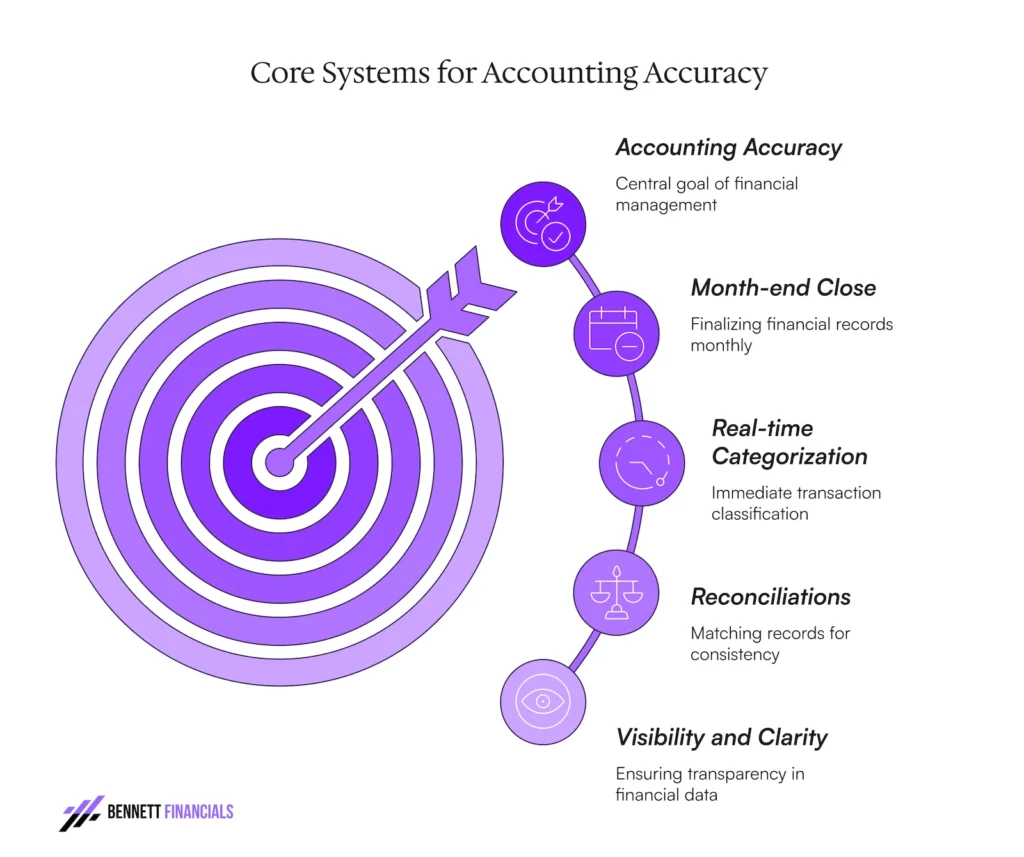
Automating tasks and reducing manual processes with accounting software can streamline the record keeping process, enhance expense tracking, and help track transactions and financial documents more efficiently.
Transition: With these systems in place, the next step is to ensure your business has strong internal controls.
Implementing Internal Controls to Ensure Accuracy
Internal controls are the backbone of maintaining accurate financial records and producing reliable financial statements. These are the policies, procedures, and checks your business puts in place to make sure every financial transaction is recorded correctly, assets are protected, and your financial reporting stands up to scrutiny. In industries with complex models or tight margins, ongoing CFO support across key industries can be the difference between catching issues early and letting them compound.
Without strong internal controls, even the best accounting software or most diligent bookkeeper can’t prevent errors, misstatements, or worse—fraud. Mistakes slip through, financial records become unreliable, and your business risks falling out of compliance with legal and regulatory requirements.
Transition: Even with strong controls, it’s important to recognize what can break accounting accuracy—and how to fix it.
What Breaks Accuracy (And How to Fix It)
Accuracy breaks down for a few simple reasons:
- Your bookkeeper is entering transactions, but no one is reviewing them.
- Your chart of accounts is bloated, inconsistent, or unclear.
- Expenses aren’t labeled properly—no memo, no receipt, just a dollar amount and a guess.
- The books are only touched monthly—or worse, quarterly.
- You’re relying on your CPA to double-check things they never even see.
None of this gets fixed by new software. Even with advanced tools, human error can still impact accounting processes and financial processes if there isn’t proper oversight and review.
QuickBooks doesn’t know that your contractor should’ve been a W2. Xero won’t tell you your team is overstaffed. Your tax preparer isn’t going to restructure your P&L so you can see service-line margins.
You need oversight. And a financial rhythm.
- Weekly categorization.
- Monthly review.
- Quarterly planning.
That’s the cadence that keeps the numbers right, and usable.
Transition: Many business owners assume their CPA will help them stay accurate, but that’s rarely the case.
Why Most CPAs Don’t Help You Stay Accurate
Here’s the truth most people don’t want to hear. Many owners also blur the line between controller and CFO, so understanding the key differences between a CFO and a controller helps you see why tax-focused CPAs rarely give you the strategic support you actually need.
CPAs are trained to file taxes. That’s it. Most talk to you once a year and are in a mad rush to finish with your account so they can move onto the next business, and the next. In fact, most CPAs are primarily focused on tax filing—ensuring your records are in order for tax submission—rather than ongoing financial management or maintaining accounting accuracy throughout the year.
They’re not looking at your margins. They’re not checking your comp model. They’re not adjusting your chart of accounts so you can actually run the business better.
Their job is to stay compliant with the IRS. Not to help you grow. Not to help you scale. Not to fix your cash flow.
When Taylor came to us, he had a good CPA. But every decision felt like a guess. The firm was growing fast, but he had no system for tying financials to strategy. He couldn’t see what was driving results, and he was still stuck in the day-to-day.
We built out a real reporting system. Tied every number to ROI. Created forecasts, cash flow maps, and a decision-making framework.
That clarity helped him scale from $20K to $2M per month while keeping 30% profit margins. And when he got a 25x acquisition offer, he turned it down—because the business was finally running how he wanted. That’s the kind of shift many owners look for when they explore fractional CFO services built for growth.
Transition: If you’re considering outside help, here’s how a fractional CFO team maintains accounting accuracy.
How We Maintain Accounting Accuracy as a Fractional CFO Team
We don’t just clean the books. We rebuild the system that keeps them accurate. If you’re considering help, it’s worth knowing how to choose the right fractional CFO services so the support you bring in actually matches your goals.
Our Approach
- We categorize expenses weekly. No backlogs.
- We close the books monthly and meet to review what changed.
- We track cash flow every week, not just at tax time.
- We help you read the numbers. Understand them. Act on them.
- We connect your financial data to your margin, growth, tax, and wealth goals.
Our approach ensures accurate bookkeeping for compliance and documentation, delivers accurate financial data for reliable analysis and benchmarking, and provides fast and accurate accounting so you can make informed decisions with confidence.
And when we find a problem, we fix it. Fast.
That’s what accuracy looks like in practice.
Transition: Technology is changing the landscape—let’s look at how AI affects accounting and bookkeeping.
How AI Affects Accounting and Bookkeeping
Let’s get this part straight.
AI helps with:
- Receipt scanning
- Transaction matching
- Categorization suggestions
- Faster reconciliation
Leveraging AI in financial management can support sound decision making and improve insights into the company’s profitability by providing more accurate and timely financial data.
But AI doesn’t know your strategy. It can’t tell if a charge is CapEx or OpEx. It won’t flag margin compression. It won’t redesign your chart of accounts.
If your system is broken, AI just breaks it faster.
We use AI tools where they make sense. But the accuracy still depends on human oversight, context, and strategy. That’s the part software can’t replace, which is why picking from the top rated fractional CFO companies in 2025 matters more than whichever AI tool is trending.
Transition: Now, let’s compare the different models for managing your books—and why separating personal and business finances is essential.
DIY vs Bookkeeper vs Controller vs CFO
Here’s how the models compare:
- DIY: You’re entering things yourself, or ignoring the books entirely. High risk, low clarity. Separating personal and business finances is essential for accurate accounting records and simplifies tax preparation. Mixing the owner’s personal finances with business finances, or failing to separate personal and business expenses or transactions, can lead to accounting errors, complicate tax filing, and reduce financial accuracy.
- Bookkeeper: You get entries and maybe reconciliations. But no reporting strategy, no analysis, no real review. It’s still crucial to distinguish personal and business transactions to maintain accurate records and simplify compliance.
- Controller: You get consistent closes, clean reports, and some oversight. But not tied to strategy, taxes, or cash flow planning.
- CFO: You get a full financial system. Books tied to goals. Strategy backed by numbers. Real-time clarity and decision support. In complex, regulated fields like medicine, for example, a fractional CFO for healthcare organizations can align compliance-heavy operations with profitability and cash flow.
The difference isn’t the software. It’s the thinking.
Transition: Ultimately, accuracy is not optional for any business that wants to grow and thrive.
Final Word: Accuracy Isn’t Optional
You can’t grow on bad data.
You can’t reduce your tax bill with delayed reports.
You can’t fix margin, forecast cash, or hire correctly unless the books are right.
Maintaining accounting accuracy is of utmost importance for a successful business, as it protects your company’s reputation, ensures regulatory compliance, and supports your company’s financial health and financial performance. Accurate records enable informed financial decisions and informed decision making, helping your business stay compliant and providing a clear view of your company’s financial position.
So if you’re asking, how do you maintain accounting accuracy?
You build a system.
You put the right person in charge.
And you stop treating the books like a formality and start treating them like the most valuable tool in your business.
Want us to help you set that up?
Talk to us. We’ll walk you through it.
FAQs About How to Maintain Accounting Accuracy – Ask a CFO
What Does Accounting Accuracy Really Mean for a Business?
Accounting accuracy means more than having clean books—it means your financial data reflects reality in real time. When your books are accurate, you can trust your reports to make decisions, not just file taxes. Every transaction is categorized correctly and reconciled monthly. Financials reveal margin by service line, not just total profit. Owners can read, understand, and act on their P&L without guesswork. Discover how we structure accounting systems that drive decision quality on our Strategic Finance page or review accounting standards from FASB.org.
Who Should Be Responsible for Maintaining Accounting Accuracy?
Accuracy depends on ownership and accountability. One person—or one team—must manage your accounting cycle from transaction entry to monthly reporting. Bookkeepers handle data entry. Controllers ensure accuracy and consistency. Fractional CFOs connect the numbers to strategy and decision-making. Without clear ownership, errors compound and reports lose value. Learn how our Fractional CFO services create financial clarity, or explore business accounting management advice from SBA.gov.
What Systems Keep Your Accounting Accurate?
Accuracy is built on process, not software. The right systems create consistency, oversight, and timely reporting. Close the books monthly within 5–10 days. Reconcile all bank and credit accounts every month. Categorize transactions weekly to prevent backlogs. Track AR/AP visibility—know who owes you and what you owe. Align payroll with margin and department reporting. We design these controls as part of our Strategic Finance systems or you can study financial accuracy frameworks on Harvard Business Review.
What Causes Accounting Inaccuracies—and How Do You Fix Them?
Inaccuracy usually comes from process gaps, not bad intentions. Unreviewed bookkeeper entries Inconsistent or bloated chart of accounts Unreconciled transactions Quarterly (not monthly) reviews Overreliance on CPAs for operational oversight Fix it by establishing a financial rhythm—weekly categorization, monthly review, and quarterly strategy planning. Learn how to implement this cadence with our CFO systems or review GAAP principles from Investopedia.
Can AI Tools Help Maintain Accounting Accuracy?
AI improves efficiency, not strategy. It’s useful for automating data capture and reconciliation—but it can’t make judgment calls. AI helps with receipt scanning and transaction matching. It accelerates reconciliation and categorization. But it can’t identify strategic misclassifications or margin issues. Human oversight remains essential. Learn how we integrate AI tools into human-led accounting systems on our Strategic Finance page or explore AI’s accounting role on Forbes Advisor.