Where Does the Money Go In My Business? (And Why Your Bank Balance Feels Broken)

On this page
Article Summary
Four claims sit ahead of you, and none of them appears as an expense: tax set-asides, debt principal, working capital absorbed by growth, and capital expenditure. That is the usual reason behind "why does my bank account keep getting drained even when business is going well?" On $2M of revenue at 12% net margin, a business growing 30% generates $240,000 of profit and can consume every dollar before you draw anything. If you're thinking "I made more money this year than ever and I still feel broke — is something wrong with my business?", it's usually the same arithmetic. The fix for "how to stop living month to month in my business" starts with an eight-week operating buffer.
Many $2M–$20M service businesses show profit on paper but can’t cover payroll without stress. Revenue grows, but the bank account tells a different story. This disconnect isn’t a mystery—it’s a pattern I see every week.
Why You’re Profitable on Paper But Broke at the Bank
A $3M marketing agency in 2025 shows 18% net profit on its income statement. That’s $540,000 in reported profit. But the operating account? Less than $180,000—not even enough cash to cover a single month of payroll.
The difference between profit and actual money in your bank account comes down to timing. Profit is what the P&L says after revenue minus expenses. Cash is the dollars sitting in your account on the last day of the month. They move on completely different schedules.
You invoice a client on net-30 payment terms. The work is done. The expense hit your books. But the customer payments arrive 30, 45, or 60 days later. Meanwhile, payroll runs weekly. Rent is due on the first. Your quarterly tax bill doesn’t wait.
The right question isn’t “Am I profitable?” It’s “Where does every dollar go between the invoice and my bank account?”

The 60% Question: What Does It Really Cost You to Deliver the Work?
Delivery costs are concrete: payroll for people doing the work, contractor invoices, software directly tied to client delivery, and any pass-through costs. This is what it takes to sell your services and actually deliver them.
For healthy service businesses, gross margin should hit at least 60%. That means delivery costs should not exceed 40% of revenue over a 12-month period.
Here’s the math: on $5,000,000 in revenue, total delivery costs should stay at or below $2,000,000. If you’re spending $2,200,000 on delivery, you’ve already lost 4 cents on every dollar before touching overhead.
The back-of-the-envelope check takes five minutes:
- Add all delivery wages and contractor payments for the past 12 months
- Divide by total revenue for that specific period
- Compare that percentage to 40%
Common money leaks I see in delivery:
- Over-staffing relative to backlog—paying people for time that isn’t billable
- Discounting projects at the last minute without reducing delivery scope
- Letting scope creep slide without change orders
After you pay the people doing the work, how many cents are really left from every dollar of revenue you bring in?
Sales & Marketing: Are You Buying Growth or Just Buying Noise?
Growing agencies, IT firms, and consultancies spend money in many businesses directions: ad spend, sales commissions, marketing contractors, CRMs, conferences, and sponsorships. The question is whether that investment converts.
As a benchmark, sales & marketing should not exceed 15% of annual revenue for a mature $2M–$20M service business.
A $2,400,000 firm in 2025 should keep annual sales & marketing at or below $360,000. That’s the ceiling, not the target.
What belongs in this bucket:
- Online ads (Google, LinkedIn, Facebook)
- Sales salaries and commissions
- Agency retainers and copywriters
- Event travel and sponsorships
- Marketing software (email platforms, CRM, analytics)
Pull last year’s P&L. Add up these costs. Divide by revenue. Write down the percentage.
Diagnostic questions that matter:
- Are you paying for leads you never call?
- Are you still funding campaigns from 2022 that no longer convert in 2026?
- Do you track which channel brought in which clients—or are you guessing?
G&A Overhead: The Quiet 15% That Silently Expands
G&A is the “keep the lights on” bucket: leadership salaries beyond delivery, operations staff, rent, insurance, professional fees, and general software. These are business expenses that don’t touch clients directly.
G&A should sit around 15% of revenue or less for a stable service business that wants to throw off real cash to owners, and strategic CFO services for business growth and stability can help you design that cost structure intentionally.
If a consulting firm brought in $4,200,000, G&A should stay at or below $630,000.
G&A drifts upward quietly over 18–24 months:
- Unused SaaS subscriptions that renew automatically
- Extra office space leased “for growth” that never came
- Admin hires made ahead of need
- Layered management that slows decisions and adds payroll
Mini-audit you can do today: scan your last three months of bank and card statements. Circle anything that doesn’t touch a client or bring in pipeline. Total that number. Most founders are shocked by what surfaces.
Every extra dollar in G&A is a dollar that never makes it to your pocket or your cash reserves.
Owner Pay, Taxes, and Debt: Where Cash Disappears After Profit
Even after hitting healthy delivery, sales & marketing, and G&A benchmarks, cash can still feel tight. The gap comes from how owners handle compensation, taxes, and loan repayments.
Owner draws and distributions pull cash out of the business without appearing as business expenses on the P&L. You see profit—but you’ve already taken it.
Tax obligations are based on profit, but actual money leaves in chunks: April 15, June 15, September 15, and January 15 for U.S. estimated payments. A strong Q1 doesn’t help if you didn’t set aside cash for the June 15 bill.
Principal payments on a business loan reduce cash every month but don’t show as expenses on the income statement. That’s why founders are surprised when their bank balance drops faster than profitability suggests.
Build this habit: move 10–15% of revenue into a separate tax and debt reserve account every Friday. Quarterly payments and loan drafts never touch operating cash.
Example: a $1,800,000 firm with $150,000 in annual loan principal and $200,000 in combined owner pay and distributions. That’s $350,000 of cash drained annually—almost 20% of revenue—that never shows on the loss statement as an expense.
Growth, Timing, and Cash Gaps: Why Fast Growth Feels Poor
Rapid growth between 2023 and 2026 has pushed many service owners into the “busy but broke” pattern. Growth eats cash before it pays cash back.
Taking on bigger contracts, hiring ahead of revenue, and ramping up ad spend forces the business to pay salaries and vendors weeks or months before client payments arrive. That’s the cash trap.
Concrete example: a firm signs a $120,000 annual contract in January 2026. Work starts in February. Team salaries run $32,000/month. But the first invoice doesn’t get paid until late March—maybe April if the client delays. The business has paid $64,000 before collecting $10,000.
Typical timing mismatches:
- Net-30 and net-60 client terms
- Annual software renewals clustering in specific months
- Quarterly insurance or tax bills creating cash flow gaps
Practical exercise: map the next 12 weeks of expected inflows (customer payments based on contracts) and outflows (payroll, rent, ads, debt, bills). Mark weeks where outflows exceed inflows. That’s your cash gap in plain numbers.
Solving cash timing isn’t about cutting everything. It’s about sequencing commitments to match the rhythm of collections.
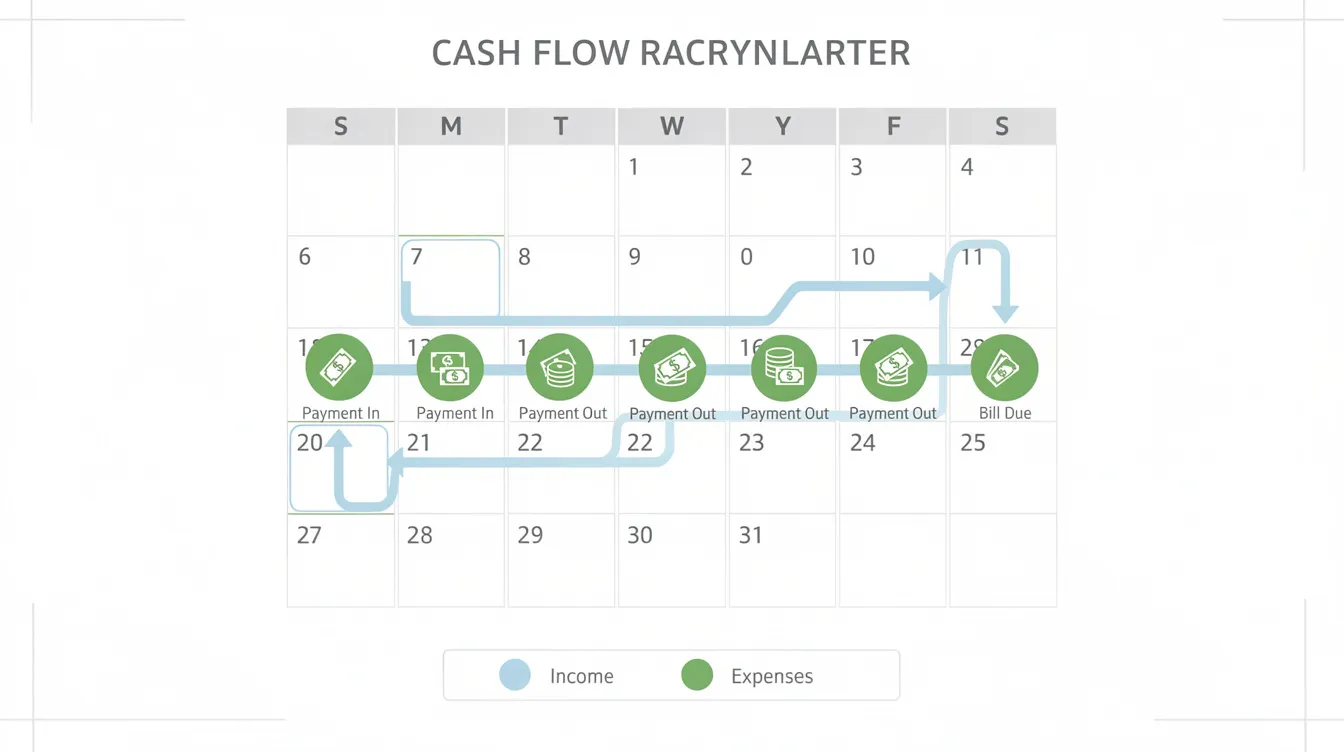
How to Find Where Every Dollar Goes: A Simple Weekly Cash Ritual
Cash management isn’t an annual panic meeting with your accountant. It’s a 30-minute Friday ritual that creates a resilient business.
Weekly checklist:
- Open the operating bank account
- List expected deposits for next week
- List must-pay commitments (payroll, rent, debt)
- Compare totals—flag any shortfall immediately
Monthly expansion—look at three reports side-by-side:
- Profit and loss statement for margins
- A simple cash flow report for timing
- AR aging report for overdue invoices
Practical moves that create enough cash:
- Shorten payment terms on new projects (50% upfront, 50% in 30 days)
- Move existing clients from net-45 to net-15 or subscription billing
- Cancel unused tools and software
- Negotiate vendor terms to align with when cash comes in
- Cap owner distributions until a one-month buffer is in place
The goal: every Friday, know exactly where next month’s payroll, taxes, and owner pay will come from.
When You’ve Outgrown Your Bookkeeper: Where a Fractional CFO Actually Helps
When a service business crosses $1M–$2M in revenue, basic bookkeeping and tax prep no longer answer “where did the money go?”—that’s when the benefits of hiring a fractional CFO start to compound.
A bookkeeper records history and files returns. A fractional CFO for service businesses does forward-looking work: cash flow statement analysis, margin analysis by service line, pricing strategy, and owner compensation design. They track profitability in real-time, not after the quarter closes.
Signs you need a fractional CFO in 2025-level help:
- Recurring payroll panic despite growing revenue
- Margin compression below 60%
- Sales & marketing regularly over 15% of revenue
- No clear plan for owner pay and taxes
At Bennett Financials, I build 12- to 24-month financial models, tighten cash cycles, and redesign pricing so businesses self-fund growth instead of living on credit. One $3,500,000 agency moved from 8% to 20% net profit over 18 months by aligning delivery staffing, tightening AR, and capping G&A at 15%.
Stop guessing. Start small with the right systems—then scale with data.
Next Step: Get an Objective Read on Where Your Money Is Going
Healthy service businesses target at least 60% gross margin, with sales & marketing near 15% of revenue and G&A near 15%. What’s left covers profit, taxes, debt, and owner pay—that’s how growth turns into wealth.
At Bennett Financials, I use these benchmarks to diagnose where cash is leaking, then help owners redesign pricing, staffing, and spending so revenue actually reaches their bank account.
Want to know where your business stands? Book a free Scale-Ready Assessment.
FAQ
Why does my bank account keep getting drained when business is going well?
Four claims sit ahead of you and none appears as an expense: tax set-asides, debt principal, working capital absorbed by growth, and capital expenditure. Those four are the usual answer to "why does my bank account keep getting drained even when business is going well?" On $2M of revenue at 12% net margin, a business growing 30% can generate $240,000 of profit and still consume every dollar of it before you draw anything.
I made more money than ever and still feel broke — what's wrong?
Nothing is necessarily wrong — you are funding growth out of profit. "I made more money this year than ever and I still feel broke — is something wrong with my business?" is the standard question from a firm converting margin into receivables and headcount rather than distributable cash. Check cash conversion: operating cash flow divided by net profit. Below 0.7 and your profit is being consumed before it reaches you.
How do I stop living month to month in my business?
Build a cash buffer measured in weeks of operating expense, then defend it with a rule rather than willpower. The practical answer to how to stop living month to month in my business starts at eight weeks of opex held separately — for a firm spending $180,000 a month, that is $360,000. Get there by holding 5% of every collection back before draws, not by waiting for a good quarter.
How do I know if my service business has a cash flow problem, not a sales problem?
If revenue grew 15–20%+ from 2024 to 2025 but you still scramble to cover payroll or taxes, the issue is margins and timing—not demand. Compare your gross margin, sales & marketing percentage, and G&A percentage against the 60/15/15 benchmarks. Consistently relying on credit cards to bridge gaps is a strong sign of structural cash flow problems even when sales look strong.
What is a healthy cash buffer for a $2M–$20M service business?
Aim for 1–2 months of core operating expenses held in separate accounts. If monthly operating costs average $250,000, your buffer target is $250,000–$500,000. Build this gradually over 6–12 months by capping owner draws and trimming non-essential overhead.
How often should I review my margins and spending percentages?
Monthly, once prior month data closes. High-growth businesses should look at a rolling 3-month view to catch trends early. Use the same report format every month so patterns become obvious.
Can I fix cash flow issues without cutting staff or slashing marketing?
Many times, yes. Start by tightening payment terms, speeding collections, and right-sizing owner pay before touching headcount. Clean up obvious overhead waste—unused tools, duplicated services, suppliers you forgot about. Delivery staffing adjustments should come from gross margin analysis, not panic.
When is the right time to bring in a fractional CFO like Bennett Financials?
The sweet spot is $2M–$20M in revenue, growing, but you can’t clearly answer where the money goes each month—an ideal fit for fractional CFO services for service businesses. Specific triggers: recurring cash crunches, confusion about pricing and margins, preparing for an exit in the next 3–5 years, or recognizing it’s time to hire a CFO over a controller. A fractional CFO makes sense when you want data-driven decisions about hiring, growth, and owner compensation instead of gut feel—and choosing the right fractional CFO services is what makes that partnership work.