Common SaaS Accounting Pitfalls and How to Avoid Them

On this page
Article Summary
The most common SaaS accounting problems are recognizing annual subscription revenue upfront instead of over the service period, misapplying ASC 606, mixing subscription and non-subscription revenue, and expensing implementation costs that can often be capitalized. SaaS companies should run accrual reporting for investors alongside cash reporting for runway, and track bookings as well as billings. Founders should review MRR, churn, CAC and LTV together every month, with LTV at 3–5x CAC. A strategic CFO's first 60–90 days should clean up the chart of accounts, review revenue recognition and rebuild forecasts.
Your product’s solid. Your MRR’s climbing. But your books? A mess. Even my lawn gets more regular attention. And it’s mostly dirt.
If you’re still relying on a CPA who files taxes and disappears, or thinking your accountant who’s never dealt with a SaaS business can “figure it out”, you’re wasting more than just time.
This is your practical guide to SaaS accounting that actually supports growth, cash flow, and a clean exit – without the fluff.
Why Most SaaS Accounting Advice Falls Flat
Cookie-Cutter Bookkeeping Is Costing You Growth
SaaS companies operate on deferred revenue, bookings vs. billings, churn, and retention cycles. None of that shows up in a generic QuickBooks P&L.
If your accountant is treating you like a dentist or a local retail shop, you can do much better.
Why CPAs Miss the Mark on SaaS
Traditional CPAs are trained to look backward. They tally the numbers, file the return, and pat themselves on the back for staying compliant. That’s not strategy. That’s paperwork.
SaaS accounting is about building a financial engine that supports recurring revenue, capital raises, and structuring the company for a potential exit.
You’re Not Just Managing Numbers, You’re Managing Momentum
Unlike traditional accounting that mostly looks backward, SaaS finance needs forward-looking decisions, and many CPAs still miss how your financial model shapes hiring, marketing, R&D, valuation, and investor trust. Every misclassified dollar affects business performance and your cash. It also makes sustainable growth harder because weak reporting can hide the cost of retention and customer satisfaction.
The Real Problems in SaaS Accounting (And Why They Compound Fast)
Deferred Revenue and Cash Flow Blind Spots
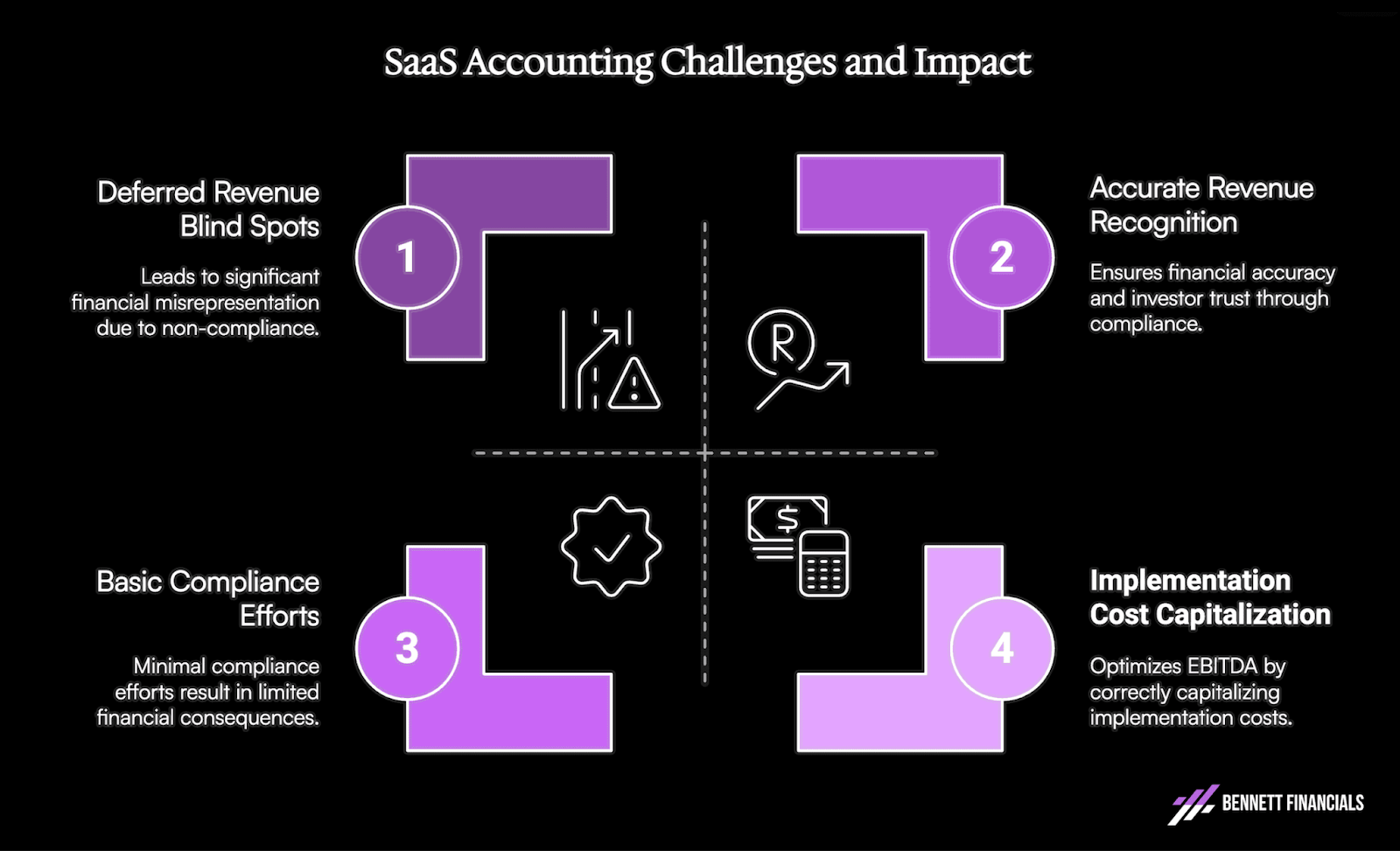
Deferred revenue isn’t just a line item – it’s a liability that represents payment received before service delivery, especially when customers pay upfront. If you’re recognizing revenue too early or not tracking performance obligations, your books lie. SaaS companies also face challenges with high transaction volumes, which makes deferred revenue management harder and increases the risk of missing future obligations. And investors notice, because service delivery drives when revenue can be recognized and supports accurate revenue reporting.
ASC 606 Compliance Confusion
Accounting Standards Codification 606 (ASC 606) is a set of accounting rules that gives guidance for all revenue from contracts with customers. SaaS companies must comply with ASC 606 and IFRS 15. IFRS 15 aligns with ASC 606 for international revenue recognition.
Since it came out in May 2014, ASC 606 changed the game, but most firms haven’t kept up with accrual accounting requirements.
Whether you’re bundling services, onboarding, or implementation fees, improper revenue recognition could trigger a restatement and destroy trust. Read our guide on SAAS Revenue Recognition and the ASC 606 Five-Step Model. In practice, saas providers need to recognize revenue correctly under generally accepted accounting principles and international financial reporting standards.
SaaS Implementation Cost Treatment Mistakes
Implementation costs and implementation services aren’t always an expense. In many cases, they can be capitalized. Miss this, and you’re reducing your EBITDA for no reason.
The capitalization point also depends on customer contracts, which can change how implementation services are separated, tracked, and recognized.
Forecasting Failure from Bad Revenue Recognition
Garbage in, garbage out.
If your revenue recognition is sloppy, it undermines financial forecasting. Automated revenue recognition improves forecasting accuracy and gives you a clearer view of future revenue streams. That means missed targets, boardroom panic, and poor decisions.
SaaS Accounting Best Practices That Actually Work
Ratable Revenue vs. Cash – How to Run Both Models
Track both: accrual accounting for your investors, cash basis accounting for survival.
Know your burn. Know your runway. cash accounting may be simple early on, but most SaaS companies need accrual accounting for accurate financial statements and financial reporting. Run dual reports so you’re not making decisions off one distorted view.
Booking vs. Billings – Track the Real Growth Driver
Billings show how much cash hit the door. Bookings show what’s been sold, and both are core revenue streams and useful key metrics for understanding growth. Together, they give you a clearer view of financial performance and support better financial management decisions. You need both—but most founders only track one. That’s a mistake.
Subscription Revenue Recognition the Right Way
SaaS companies in a subscription based business model cannot recognize annual subscription revenue upfront. Revenue must be earned over time unless performance obligations are satisfied.
It should be recognized over the service period and posted to the right revenue accounts until earned. Yes, it’s tedious. But it protects your valuation, and your sanity.
Metrics That Matter: MRR, Churn, CAC, and LTV
If you’re not tracking these monthly, you’re operating without context. Here are the key saas metrics, how to calculate them, and what they tell you. These saas specific metrics help assess business health and long-term performance. Monthly Recurring Revenue predicts future business health, and Customer Lifetime Value estimates total revenue from a customer.
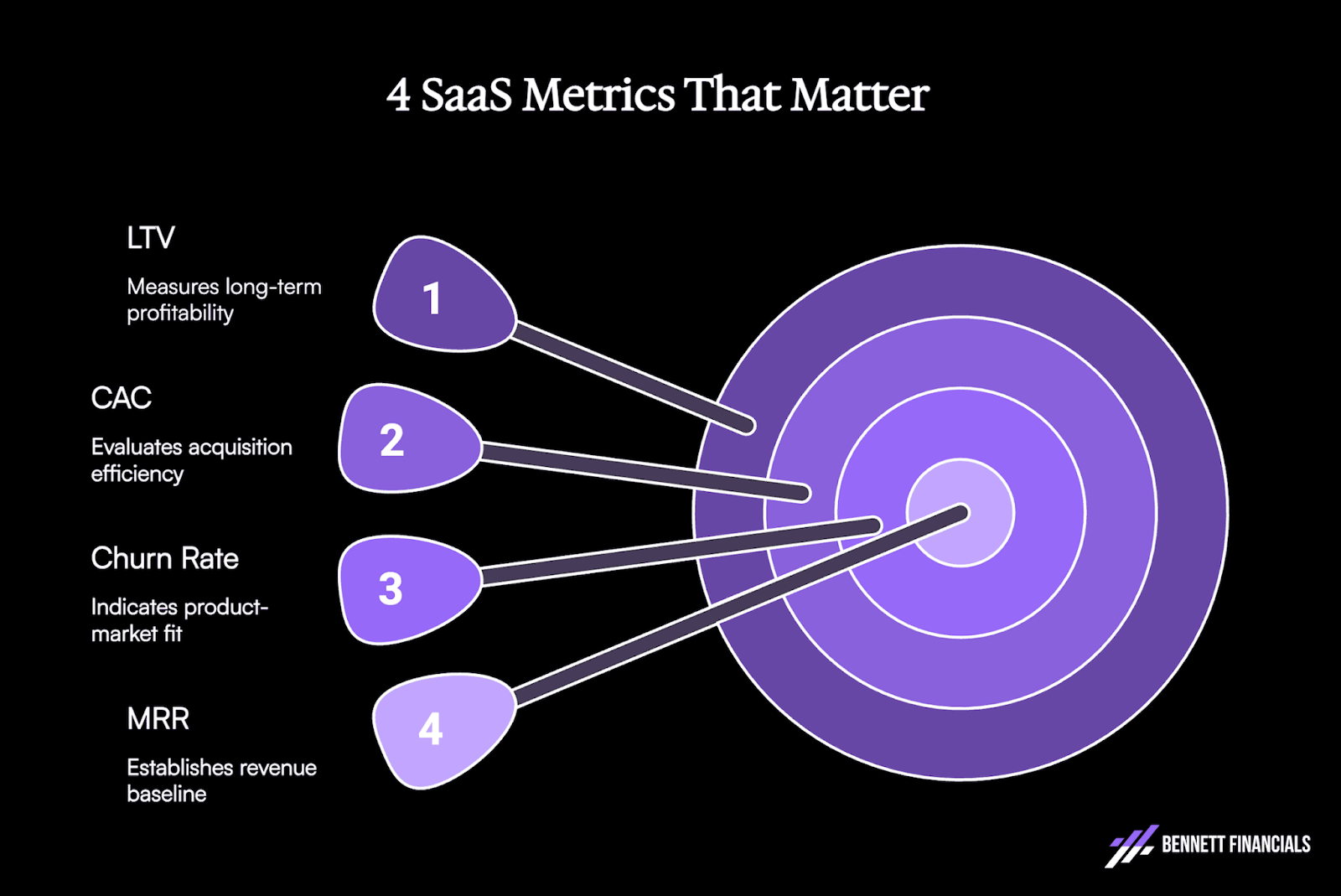
1. MRR (Monthly Recurring Revenue) – The Baseline
Formula:
Total Active Subscriptions x Average Monthly Price
Why it matters:
It’s your baseline. Everything else builds on this.
2. Churn Rate – Product Fit
Formula:Number of Customers Lost During the Month ÷ Total Customers at Start of Month) x 100
Why it matters:High churn kills growth – even if MRR looks solid. It also weakens customer retention and signals strain in long-term customer relationships. Track this by cohort, not just overall.
3. CAC (Customer Acquisition Cost) – How Efficient are You Scaling?
Formula:Total Sales + Marketing Spend ÷ Number of New customers Acquired in That Period
Why it matters:Shows what it costs to acquire each new dollar of MRR. customer acquisition cost cac is also a basic sustainability check when you compare it with customer lifetime value. Too high? You’re scaling inefficiently.
4. LTV (Customer Lifetime Value) – Is Your Model Profitable?
Formula:
Average Monthly Revenue per Customer x Average Customer Lifespan (in months)
Why it matters:
Tells you how valuable a customer is over time. Compare this to CAC to spot issues in your model. LTV should be 3–5x your CAC.
Most teams track MRR. Fewer track CAC and churn accurately. Almost no one ties all four together consistently. That’s where the insights – and decisions – live.
Advanced SaaS Tax Strategies Your CPA Won’t Mention
Why Your Revenue Model Is Your Biggest Tax Lever
Deferred revenue can be used strategically to manage your tax burden, if done legally. Varying tax rules can also change how deferred revenue affects tax timing for software companies.
Most CPAs don’t even touch this. Hire a tax specialist that does this every day.
Structuring for Scalability and Legal Zero-Tax Outcomes
S-Corps. Subsidiaries. Multi-entity setups. Does your accountant know the best structure for your growth?
One indicator: if you have $1-$10M in revenue and are paying six figures in taxes every year, there’s another way.
How to Turn Implementation Costs into Future Deductions
Implementation, onboarding, and setup fees can often be amortized.
Most CPAs expense them. That tanks EBITDA. You want to capitalize where possible, especially if you’re gearing for exit.
Real Estate, Augusta Strategy, and Owner Retreats for SaaS Execs
If you’re scaling and not using advanced strategies like:
- The Augusta Rule
- Real Estate Professional Status (REPS)
- HSAs and cost segregation
- Owner retreats
You’re leaking tax dollars. We don’t patch leaks, we reroute the flow.
Common SaaS Accounting Mistakes (and How to Fix Them)
The Reactive CPA Problem
Most CPAs have one job – filing taxes in April. That’s it. You hear from them once a year.
No projections, no planning, no strategy. It’s like driving a race car with no brakes, and no map.
Mixing SaaS and Non-SaaS Revenue
Selling consulting, training, and subscriptions? Good.
Treating them the same in your books? Bad.
Different rev rec rules apply. Mix them up, and you’re out of compliance.
Misclassifying Contracts and Renewals
Annual contracts vs. monthly make a huge difference in how revenue is booked, especially when annual deals mean customers pay upfront even though revenue is earned over time.
Misclassify, and your revenue spikes or dips artificially, destroying forecasting and trust.
Those upfront billings also create future obligations until the service period is complete.
It’s like putting Vegemite on toast thinking it’s Nutella. Technically legal, but definitely the wrong flavor.
Ignoring the Balance Sheet
Founders focus on P&L. Deferred revenue on the balance sheet represents payment received before service delivery. But your deferred revenue, prepaid expenses, and capex sit on the balance sheet.
That balance sheet context supports accurate financial statements and better financial clarity. Ignore it, and your financial story is incomplete.
When to Outsource Your SaaS Accounting (And What to Look For)
In-House vs. Fractional: Where the Real ROI Is
Full-time CFOs cost $250K+. Most don’t pay for themselves. And unless you’re dealing with complex capital structures or raising a large round, you might not need one.
Consider an outsourced / fractional CFO. They give you C-suite strategies without full-time overhead. When done right, they bring structure to your numbers, help clean up recurring issues, and build a financial model you can actually use to make decisions.
The right setup depends on stage and needs. But if you’re making decisions based on gut feel or lagging reports, it’s probably time to bring someone in.
How to Vet Strategic Finance Partners
Not all “CFOs” are operating at the same level. Some are just bookkeepers with upgraded titles.
Ask real questions:
- Do they understand both compliance and strategy?
- Have they worked with SaaS businesses at your stage or slightly ahead?
- Can they explain deferred revenue, ASC 606, and investor expectations without overcomplicating it?
Strong finance teams need partners who can unify revenue data and support accurate financial reporting as the company scales.
Good finance partners ask better questions than they answer. They make you rethink how your business is structured, not just how it’s tracked.
What a Strategic CFO Focuses on First
The first 60–90 days should focus on:
- Cleaning up chart of accounts
- Reviewing how revenue is recognized
- Rebuilding short- and long-term forecasts
- Checking entity structure and tax opportunities
- Making sure reporting reflects how the business actually runs
- Strengthening financial operations with integrated systems and the right accounting software
Integration of accounting tools improves data accuracy and speeds up reporting.
It’s not about overhauling everything—it’s about tightening what matters.
Signs You’ve Outgrown Your Current Setup
- Your books look fine but don’t tell you much
- Forecasting feels disconnected from reality
- Metrics aren’t consistent across reports
- You’re paying taxes but don’t know why (or if it’s the right amount)
- There’s a growing list of “we’ll deal with that later” in your finances
Weak processes reduce accurate reporting and make financial statements less useful for decisions.
These things usually start small. But over time, they slow down decisions and create risk when it matters most – like fundraising, exits, or audits.
The SaaS Accounting Checklist
Must-Have Reports and Metrics
- MRR & annual recurring revenue (ARR), key metrics for measuring business performance and evaluating future revenue streams and overall business health
- CAC, LTV, churn
- Revenue waterfall
- Cash flow forecast
- Deferred revenue schedule
Monthly Close Process
- AR/AP reconciliation
- Deferred revenue adjustment
- Use automation to automate revenue recognition and reduce manual errors.
- Automated systems help process high transaction volumes efficiently while maintaining ASC 606 compliance in real time.
- Board-ready financial package
- Performance obligation tracking
Audit-Prep and Compliance Workflows
- Contract audit trail for customer contracts
- ASC 606 compliance binder, with proper SaaS accounting practices supporting accurate revenue reporting and clean financial statements during audits
- Revenue recognition schedules
SaaS Accounting Tools and Integrations That Work in 2025
- Gusto for payroll
- Fathom or LivePlan for forecasting
- Stripe + Chargebee + SaaSOptics integrations to improve financial reporting and support deferred revenue management
- QuickBooks Online (but customized for SaaS to fit the saas business model and recurring revenue models)
Ready to Clean Up Your Books and Cut Your Tax Bill?
If you’re making $2M-$10M+ and serious about growth, this isn’t optional.
Reactive accounting is killing your cash flow.
We offer more than theory. We offer outcomes.
Want the real numbers? Let’s talk. Schedule a consult.
FAQs About Common SaaS Accounting Pitfalls (and How to Avoid Them)
Why Doesn’t Traditional Accounting Work for SaaS Companies?
Traditional accounting focuses on one-time transactions and simple cash flow tracking. But SaaS businesses operate on recurring revenue, deferred income, and performance-based delivery—models that traditional accounting systems can’t handle accurately. Revenue is recognized over time, not all at once. Deferred revenue represents unearned income—an essential liability. Customer churn, renewals, and upgrades affect revenue recognition. If your CPA treats your SaaS company like a retail or professional services firm, your books—and your valuation—are likely off. Learn how to build SaaS-ready financial systems on our SaaS Accounting page or review the fundamentals on Investopedia.
What Is Deferred Revenue and Why Is It So Critical in SaaS?
Deferred revenue is money collected for services you haven’t yet delivered. It’s not income—it’s a liability. Recognizing it too early creates misleading financials, inflated revenue, and inaccurate tax exposure. Deferred revenue protects your cash flow by matching income to delivery. It ensures compliance with ASC 606, the standard for revenue recognition. It provides transparency to investors and buyers evaluating your SaaS model. If your deferred revenue schedule isn’t tracked monthly, your numbers can’t be trusted. Learn more about deferred revenue management on our Strategic Finance page or read ASC 606 guidance on FASB.org.
What Is ASC 606 and How Does It Affect SaaS Companies?
ASC 606 is the accounting standard that governs how businesses recognize revenue from customer contracts. It requires companies to record revenue as performance obligations are satisfied—not simply when cash is received. For SaaS firms, this means: Recognizing subscription revenue ratably over the contract term Properly accounting for implementation or onboarding fees Separating bundled services into distinct performance obligations Failure to comply can lead to restatements and valuation damage. For ASC 606-compliant reporting systems, see our Fractional CFO Services or study compliance details on IRS.gov.
What Are the Most Common SaaS Accounting Mistakes?
SaaS companies often make avoidable errors that skew metrics and mislead investors. The top mistakes include: Recognizing revenue upfront: Violates ASC 606 and distorts MRR/ARR. Mixing SaaS and consulting income: Each has different recognition rules. Failing to capitalize implementation costs: Reduces EBITDA unnecessarily. Ignoring the balance sheet: Deferred revenue and prepaid expenses matter. Running on outdated QuickBooks setups: Lacks SaaS-specific insights. These mistakes compound fast—especially during audits or due diligence. For expert cleanup, visit our Tax Planning page or see SaaS accounting standards explained on Forbes Advisor.
Which SaaS Metrics Should Every Founder Track Monthly?
There are four core metrics that drive every SaaS company’s financial story: MRR (Monthly Recurring Revenue): Total active subscriptions × average monthly price. Churn Rate: Customers lost ÷ total starting customers × 100. CAC (Customer Acquisition Cost): Total sales + marketing cost ÷ new customers acquired. LTV (Customer Lifetime Value): Average monthly revenue × customer lifespan. When tracked together, these metrics reveal growth efficiency, product fit, and long-term profitability. Learn how we design SaaS reporting dashboards via our SaaS Finance Services or review metric definitions on SBA.gov.